Classes
Class listings are for the tri-state area; NY, NJ and PA. NJ Belly Dancing does not endorse any particular style or class nor does the site have any affiliations or obligations in regards to the Instructors listed.
Dance Phillipsburg
474 South Main Street, Phillipsburg, NJ 08865 908-387-0116
http://www.dancephillipsburg.com/dancephillipsburg.com/Home.htmlBelly Dance Classes
Yoga
Little Hearts
ActingClass Schedule: http://www.dancephillipsburg.com/dancephillipsburg.com/Schedule.html
Bellydance Revolution: Located in Morristown, NJ. Learn tribal fusion style
bellydance with Kim! Beginner class Mondays at 6pm, Mixed Level class Thursdays
at 8pm, Advanced class Thursdays at 9pm. Learn complete choreographies and get
the opportunity to perform with our group and/or as a solo act.
www.BellydanceRevolution.com
Black Bear at the Oasis: We are are Tribal Troupe with Cabaret roots! Come and join us in the fun of learning American Tribal Style belly dance! We meet at Nash Dance Center in Randolph, NJ on Thursday nights. Check us out and sign up for lessons at www.blackbearoasis.com . Like us on facebook at Black Bear at the Oasis. Contact us at info@blackbearoasis.com. Hope to dance with you soon!
Cassandra Londono:
Private at home lessons for women located in Northern NJ, the classes I offer include- basic beginner bellydance, intro to tribal fusion, and introduction to dancing with props (veils, fans, etc). Also..beginners bellydance class at Grooves Unlimited Dance Studio in Cedar Grove and Art of Dance in Chester,NJ . www.cassandralondono.com , cassandralondono@aol.comJennifer Anya Imashev: Folkloric Fusion. Dance Phillipsburg in Phillipsburg, NJ and class is at 8 pm on Mondays.www.dancephillipsburg.com Also in Catasaqua, PA at the Gas House. http://thegashousedancehall.com/
Melissa Rae:
Local to Morristown and and want to try out a belly dance class? Check out South Street Dance!
New semester starts second week of January! Inquire about my belly dance classes by emailing or calling the studio. ALL ages/skill levels welcome! Weekly class is 6:30-7:30 on Thursdays. Available for private lessons weekdays after 5PM and all day Thursdays. Please contact Emily at South Street Dance for more information. https://www.facebook.com/MelissaRaeBellydance
Upcoming Workshops:Don't miss my next workshop! Friday night girls bellydance BYOB at South Street Yoga and Nutrition! ... calling all local to Morristown ladies interested in learning the ancient art of bellydance... we will be doing a tribal fusion routine with a drum solo! We will also incorporate scarves as props in our routine. All materials will be provided. BYOB and bring a friend. $30 pp $5 discount if you register before 1/15. Use the code Belly. Register here:https://clients.mindbodyonline.com/classic/home?studioid=23181Marisa Rojo: ATS class at Karma Bar Yoga Studio. Classes for the 2019 year commence Thursday, January 10. Classes are $10. Spring Lake Heights , New Jersey. C. 732.925.8344
Naja: Specialization in American Tribal Style (GS certified), Staten Island. Classes will begin: March 1 at Staten Island’s beautiful Snug Harbor Cultural Center, 1000 Richmond Terrace, Building G. Now in Brooklyn also, Contact Naja: Naja_dancer@yahoo.com
Ramseck Cesar:
Tribal Fusion at Breath Yoga center in Brick. http://breatheyoganj.com/Solstice Studio: Solstice Studio is the only bellydance studio in NYC that focuses on Tribal Fusion, specifically East Coast Tribal. Besides technique classes we offer specialty classes that allow dancers to explore other paths to help them discover their respective voices. www.boldbellydance.com
Tapestry Tribal: Classes in : Royersford and West Chester, PA, also Wilmington, Delaware: http://www.tapestrytribal.com
Tricia: Dance Phillipsburg in Phillipsburg, NJ and class is at 6:45 pm on Weds. ATS www.dancephillipsburg.com
Aasiyah:
Professional training in Egyptian and cabaret style classes offered for Central New Jersey Area, Piscataway: www.aasiyahdance.com or 908-930-7389 for details.
Amira Mor International Entertainment Company: Offering beginner to advanced, Tuesday thru Saturdays @ the Amira Mor Performing Arts Center in Hasbrouck Heights: https://www.amiramor.com/
Azizah of 'Desert Reveries Belly Dance':
In September of 2013: Offering a beginner's belly dance class: Thursdays 9:00 to 10:00 a.m. and Fridays 7:30 to 8:30 p.m. Strauss Performing Arts in Edison, NJ. http://straussperformingarts.webs.com/aboutus.htm . Contact Azizah: http://azizahdance.webs.com/
Audi: Instructor of Egyptian Cabaret & North African Tribal. Classes in Montclair, Livingston: http://www.bellyrhythm.com
Bellydance Revolution:
Located in Morristown, NJ. Learn cabaret style bellydance with Aasiyah through technique drills and fun choreography! Beginner class
Saturdays at 1pm, Mixed Level class Tuesdays at 7pm. www.BellydanceRevolution.com
Chadia:Egyptian style dance classes for all levels. Classes in Belleville, Nutley and Hoboken: www.gypsycaravanenterprises.com
D'vorah: Cabaret Style Dance Class with D'vorah. http://www.myspace.com/desertreveries at Metuchen Dance Center starting Oct 6Th. Every Tuesday evening, 8:00. http://www.metuchendance.com/
For More Information Call (732) 549-2244
Diana Jelena:
Diana Jelena’s belly dance roots are in NY, NJ and PA. She was trained by Ibrahim Farrah and Sivasa, and performed for years in such landmark venues as Club Ibis and the Darvish in NYC and Molfettas and Vienna Gardens in NJ. In addition to a myriad of solo performances, her favorite pastime was delivering “bellygrams” to various places of business and party venues. She was also a long-time member of the troupe “Dances of Samarkand” -- performing specialized dances such as veil, sword, cane and candelabra. Diana's dance style is Classic American Cabaret, which traditionally incorporates the use of finger cymbals (zils). Diana Jelena now focuses on Beginner and Intermediate belly dance instruction in Atlantic City and South Florida. Additionally, she offers Female Celebrational parties such as bachelorette, birthday, and graduation celebrations. Diana never stop being energized and uplifted by this amazingly beautiful dance form. Diana Jelena may be reached at 732-261-6525 or dmtmiller21@aol.com. Visit her website at http://thegoddessexperienceonline.vpweb.com
EsSaM Mounir: Egyptian Dance Master Teacher, NY
Mob: +20123549656
E-mail : essamdance@gmail.com , essamdance@yahoo.comElaine: Belly Dance ( Cabaret Style ), Hunterdon Health & Wellness Center in Clinton ( no membership required ). Saturday mornings 12:00-1:00pm. For more info: 908-735-6884.
Evadne Sarai:
Cabaret-style classes in a fun, supportive environment! Beginners welcome, all sizes and shapes celebrated. Classes in Central Jersey, including Matawan, Old Bridge, and Freehold. Private or semi-private lessons available. For more information, visit www.EvadneSarai.com , like Evadne at https://www.facebook.com/evadnesarai ; or write evadne@evadnesarai.com .
Gia al Qamar: Arabic Nightclub Style, American Cabaret, Turkish, Egyptian, Fusion. Classes in Northern New Jersey including Clifton, Nutley & Wayne: www.IDreamOfGia.com
Helewa: Helewa: Arabic Cabaret, American Cabaret, and Egyptian Style. Classes in Midland Park, Parsippany, Hawthorne. Classes for all levels: www.dancinghelewa.com
Jessica Moss: Belly Dance Classes in Egyptian/Turkish/Cabaret styles on Thursday evenings from 7:30 - 8:30pm. Open level classes are ongoing. TsunamiDance Studio in Riverton, NJ. 609-731-2429. www.tsunamidance.net
Leila: Various styles of cabaret, available for private lessons. Classes in Clifton and Ridgefield: ShimmeyLeila@aol.com
Lisa:
Middle Eastern and Mediterranean Percussion for Dance Classes and for Bellydance Performances~ Email Lisa at LisaMarie3927@gmail.com
Mikele: Instructor American and Egyptian Cabaret - Classes in Northwest New Jersey including Dover and Randolph, NJ: http://www.myspace.com/twinmomdancer
Morocco Academy of Mid-Eastern Dance:
Classes are now held at CAP21 studios:
18 West 18th Street (between 5th & 6th Avenue), 6th Floor – studio 603
New York, NY 10011. 2 blocks closer to the subways than my former studio.
14th Street stop on the Q, N, R, L, 4, 5, 6, (use the 16th Street exit) F (also has a 16th St. exit) , PATH, 2, 3, 1. For info call: 718/859-0144. http://www.casbahdance.org/events/classes/
Morgiana Celeste: Styles: Classical, Cabaret, Folklore, Fusion. Strong emphasis on proper technique. Group classes in South Orange; private and semi-private classes in Glen Ridge. Also: South Orange, www.TheBaird.org , www.morgiana.com
Nacira: Classes in Denville, Rockaway, Roxbury (Morris County): Nacira@optonline.net
Najla: Najla is an Egyptian-style belly dance performer and instructor who brings the spirit of the Middle East to New York City and beyond through the beautiful art of belly dance. Her performances and classes focus not only on the joy, entertainment, and excitement of dance, but also on presenting Middle Eastern dance in a positive, culturally-informed light. Group lessons, workshops and private coaching available in New York, NY and Princeton, NJ. Visit http://www.najlabellydance.com/classes.html for current class schedules.
Noora Aphrodite:
Noora teaches the art of classical belly dance as a basis giving the student a strong foundation using the Serena Technique. Special attention is given to improvisation, technique, musicality, choreography, performance as well as other areas. She is also versatile in many other genres of belly dance and specializes in coaching one on one to bring out the best in the student. Beginner and intermediate classes are offered on a weekly schedule in Manhattan. www.nooradance.com
Ra'idah: Gloucester Township Recreation Department, next session in September. This class is only open to residents of Gloucester Township. Register @ Gloucester Township Rec. Dept.: www.raidahdance.com
Renee:
Traditional Belly Dance- This is the perfect class to start you on your journey of learning the mesmerizing art of Belly Dance. Turns, shimmies and dance steps, hip bumps and drops. This class is for those that want to DANCE!! Join our friendly belly dance community and let's get started! Woodbridge, NJ www.p2polefitness.com Check website for current schedule and available deals.
Reyna Alcala: Rutherford, authentic Middle Eastern style. http://www.reynalive.com/classes.htm
SaFire:
SaFire shares all the secrets to her hypnotic movements used in the art of Belly Dance. Experience expression and power, seduction with grace. Build self confidence, balance & tone up all in one class! Tuesday's from 6:30pm - 7:30pm (starting 2/28/12) Belly Dance Boogie at The YMCA of Ridgewood NJ: http://www.ridgewoodymca.org/ , Saturday's from 11:00am - 12:00pm (continuous) Belly Dance Class (all levels) at The GYM of Engelwood NJ: http://www.gettothegym.com/englewood/default.asp . www.safirebellydance.comSakara Amyra: Egyptian Cabaret, zill workshops.Denville, Rockaway, Oak Ridge. SakaraAmyra@gmail.com
Shaula: Classes in Park Ridge: www.silkdancer.com/classes.html
Tasha: Owner of Dance Phillipsburg : info@dancephillipsburg.com
Classes at all levels at Dance Phillipsburg, intermediate/advanced level class at Studio Yogo in Madison. http://www.tashabellydance.com/Classes.html
Tashira Wadiya: Egyptian Middle Eastern dance, Toms River: tashirawadiya@gmail.com or (908) 296-6322.
TORKOM MOVSESIYAN:
at The Art of Fitness, 32-32 Steinway Street, 3rd Floor (Between Broadway and 34th Avenue) , Astoria, NY 11103 . www.torkomada.weebly.com
Yasmeen el Qa'hira: Yasmeen el Qa'hira: Egyptian classical, cabaret, and folkloric style dance classes held in East Rutherford ,
Edgewater and Tenafly.
For info: yasmeenelqahira@yahoo.com ,
http://www.yasmeenelqahira.com
http://www.youtube.com/user/YasmeenElQahira
http://www.meetup.com/BellydanceNewJersey/
Zarouhi: Classes in Red Bank, Fair Haven, (Raqs Sharqi). For Middleton, Lincroft contact: MONMOUTH PARKS SYSTEMS, CHRIS DAVINO: 732-542-1642, EX 26. Long Branch at Vollare studio: http://www.vollarestudio.com/schedule/ , http://www.zarouhidance.com/classes.htm
Zia Renée:
Beginner/intermediate Egyptian style / Raqs Sharqi classes. Technique classes on Fridays, 6-7pm. Veil classes on Fridays, 7-8pm. Paramus Community School - 145 Spring Valley Road, Paramus, NJ. Register for classes online at the Paramus Community School or at www.ZiaRenee.com .
Zoraya: of Embers and Emeralds, Third Street Alliance, 41 North Third Street
Easton, PA www.thirdstreetalliance.org
Alexia Multi-cultural Productions: www.alexiadance.com
Philosophy: Strong foundation of dance movement, belly dance technique, musical understanding and the creative process are the things that drive me. Applying all of this to any and all stylizations is my philosophy. My hope is that each time you see me dance you learn another facet of what is going on creatively for me at that particular moment. And for my students, that each explores their own path and has their own voice with a strong base and ongoing process of growth to support that. Classes in Quakerbridge Mall area and Middlesex County College in Edison: http://www.drumdancecenter.com/
Amira Mor International Entertainment Company: Offering beginner to advanced, Tuesday thru Saturdays @ the Amira Mor Performing Arts Center in Hasbrouck Heights: https://www.amiramor.com/mainSite/index.php?option=com_content&task=view&id=127&Itemid=31
Aysha: Jersey Shore/Wall , 732-840-5768, clairesmoon2@yahoo.com,
Bellydance Revolution:
Located in Morristown, NJ. Bolly meets Belly! Check out
our Bollywood Dance classes on Thursdays at 6pm. www.BellydanceRevolution.com
Caribbean Rose: ALTAGRACIA BRUNO ~ SPANISH ARABIC FUSION & MIDDLE EASTERN DANCE, NYC. rosadelcaribe1@msn.com , http://www.caribbeanrose.com
Deniz Isler:
Classical and fusion belly dance instructor from beginners to advanced at my home in Woodlciff Lake, NJ.201-893 1998.
Donna:
Belly Dance Series w/ Donna, Sunday, June 29at 2:30pm. Garden of Healing Yoga & Wellness Center
49 Bayard St 2nd Fl, New Brunswick, New Jersey 08901
Tickets Available: www.eventbrite.com , Dance Learning Center to learn new dances, have fun and burn calories! 60-minute class offered weekly at least one of the following times, based on demand. Fridays 1:30p 7/11 to 8/29, Fridays 2:30p 7/11 to 8/29, Sundays 2:30p 6/29 to 8/24 with no class 7/13. To sign up, choose your preferred day/time and purchase a multi-class card: 5-classes = $80, 10 classes = $150,15 classes = $200. https://www.facebook.com/events/771319639555326/?ref_dashboard_filter=upcoming
Genasis: Techno: INFUSED GOTHIC,LIQUID TRIBAL CABARET,ORIENTAL, AND CLASSIC. Wednesday nights in Hamburg, NJ at The Body Botique. kipilla@ptd.net
Hayat: Beginner classes in basic isolation in Wayne. Influences include Tribal and Classical Egyptian. hgul@optonline.net
Jessica Lynne:
Experience the joy of belly dancing with Jessica! Learn how to connect your body and spirit, let go, and enjoy yourself! You will the basics to the all facets of belly dance - hip circles, lifts and drops, shimmies, snake arms, and more. This class is open to anyone and everyone looking to learn the fluid are of belly dance. Classes are Tuesdays at: On the Move Performing Arts Center - 1574 State Rt. 23, Butler, NJ, 07405 at 7:45pm. For more information, please call: (973) 570-6789, email bellyofthebeastdance@gmail.com , or visit www.bellyofthebeastdance.com
Kelebek Beyaz :
American Style Belly Dance and Tribal Fusion. Thursday evenings from 7:15-8:30 and Saturdays, 1:15 - 2:15. All classes taught at home studio: Berlin. www.kelebekfusion.com ,
http://www.youtube.com/user/KelebekBeyaz
Leandra Galasso:
NEW Belly Dancing Classes in Rutherford, NJ at Backstage Performing Arts Center
Starting January 28th *10-week series on Saturdays from 6:30-7:30
All levels welcomed! New, exciting, sexy choreography will be taught!
Register at http://www.backstageperformingartscenter.com/
Drop-Ins Welcome! These classes will be taught by - Leandra Galasso, a professional Belly Dancer and instructor for the past ten years!
Ronnie's Dance Studio: Tuesday Nights, November 7, 14, 21, 28, Dancing with Scarves. This is not the same as veils, it's 2 nylon scarves about 24" square, but with belly dance moves. It's something everyone can do for upper body exercise and toning. Class cost is $25 for 4 weeks introductory price. Tuesday Nights, December 5, 12, 19, 3 weeks $25, Intro. to Belly Dancing for Fun & Fitness. Tone up your body while gaining strength and flexibility by learning simple moves like snake arms, shimmies, undulations, and more. No previous experience necessary. Great for beginners.393 Maxim Drive Hopatcong, NJ 07843 973-234-5234Sadida Rose: Teaches an Intro to Bellydance class on Monday nights from 8:30 - 9:30 pm at http://www.fairhavenyoga.com . She is teaching alternate Wednesday nights at 6:30pm at the Croyden Gym in Middletown, NJ. The class is co-taught by Mihrimah. To find out more about Sadida Rose go to http://www.sadidarose.com
Sandi Cohen: My "Senior" Classes(55 and up) are held on Monday in Englewood SESCIL at 9:00am 228 Grand Ave, Wednesday in Cresskill at 9:30 am 38 Spring Street, Thursday in Hackensack on Moore Street, Hackensack Multicultural Center, 9:30 Fridays at The Richard Rodda Center in Teaneck at 10:30. I teach privately at home to those who want to learn basics and will do birthday party classes for girls. My style is very traditional with the addition of some Alien Fusion and special methods for those with health issues. I studied the dance with Serena Wilson in NYC in the late 1960's and have continued to teach classes and take classes through the years and four kids. Now I actually prefer to teach Seniors, who are alot of fun and often dance far better and more seriously than their own daughters and grands! "Age does not define us". sanndi@msn.com
Sherri: Offering classes in Lafayette Village, Sparta, Wantage and also in Pike County: http://www.dancingchampagnegirls.com/dance.htm
Suzanne: My focus is about empowerment, connecting to our own divine feminine essence, getting some exercise through a more creative approach and feeling a sense of wellness through the art of Middle Eastern Dance. My primary teacher was Turkish however I include Egyptian, Moroccan and even some Kathak movements into my lessons. My e-mail is Suzzah@aol.com My classes are held in my home on the North Shore of Staten Island. I also teach privately in New Jersey. My voice mail number is 718 816-5369. One can contact here regarding classes as well.
Tajeer Talda Danse Tribe: 'Belly Basics, Beginning Belly Dance' Class in Lincroft Wednesday nights at the Unitarian Universalist Congregation of Monmouth: http://www.uucmc.org/, www.myspace.com/tajeertalda
Trinity Belly Dancer: Empowerment, Mental & Physical Health & Spirit, Focus, Balance, Concentration, Comradery, Sensuality. Find your wellness through dance! Montville and Montclair: http://trinitybellydancer.com/lessons2.htm
Yudita: Matawan: Thursdays from 7:45 PM to 8:45 PM: Beginners Belly Dance
Sunday and Monday classes by demand. LOCATION: Matawan Fitness, 347 Matawan Rd.
Matawan, NJ 07747. http://www.myspace.com/BellyDanceYudita ,
Diana Jelena: Bellydancercize classes. Utilizing core belly dance moves as a fitness class, combining core movements for toning and flexibility and mini-choreography for cardio. Available for private to group classes and corporate fitness classes. Call 732-261-6525, or email dmtmiller1@aol.com. Visit https://www.facebook.com/diane.miller.71066#
Amber Davies-Chazukow:
Cardio Belly Dance class. Class featured a fusion of different belly dance moves and styles at a fast pace so you get a really good workout and improve your belly dance technique. It is for all levels of dancers, beginners are welcome. I teach Tuesday and Thursday nights at 6:00 at the Mindful Body Health and Wellness Studio in Pompton Lakes NJ. www.mindfulbody.info
Mihrimah: Teaching and performing the art of belly dance for nearly 20 years. Egyptian, Turkish, Gypsy, Gothic, Fusion. Belly Basics classes in Hazlet at Bayshore Fitness, Tuesdays at 7pm, and Core Cardio Belly Fitness classes in Leonardo at Croydon Hall Gym, Wednesdays at 6:30pm (call 732-615-2260 to register) and private and semiprivate lessons in Middletown . www.shimmyspirit.com .
Casadei Studios:
ONLINE (All you need is Skype). Cabaret and Tribal Belly dance and Bollywood Classes. Contact email info@CasadeiStudios.com . Sign up here: http://casadeistudios.com/classes/online-classes/Dalia Carella: http://www.daliacarella.com/onlineclasses.htm
Audie: http://www.bellyrhythm.com/products.html
Alexia's Belly dance and Beyond: was founded by teachers/ performers Kim Leary and Dave Merritt. Their combined experience and appreciation of music and dance led them first to collaborate on multi-cultural projects, then to form the DDLC with this vision: To provide a welcoming atmosphere that promotes creativity and learning in the percussion and dance arts of many cultures and their corresponding anthropologies. The Drum & Dance Learning Center encourages personal growth and provides foundational learning skills through on-going classes, workshops and student performance opportunities as well as lectures with guest instructors. The courses are designed to meet the needs of both the casual student and those students with a life long dedication to learning. The Drum & Dance Learning Center believes that personal dedication to an artistic discipline whether as a hobbyist or professional, develops essential life skills. These include: communication, teamwork, cultural awareness and understanding as well as developing aesthetic values, problem solving and analytical skills.
Our classes offer an atmosphere of learning with students of similar skill levels. The class size is designed to provide each student with individual attention, while allowing the entire class to progress through the series. Students may choose a specific series of classes or set up their own course study of the class series offered at DDLC. Students may also enroll in our Performer Program, a curriculum DDLC has developed to prepare students and give them all of the essential tools, skills and knowledge necessary to succeed.
~Each entered the forest at a point that he himself had chosen, where it was darkest and there was no path. If there is a path it is someone else's path and you are not on the adventure.~ -Joseph Campbell QUAKERBRIDGE VILLAGE COMMONS
4054 Quakerbridge Road
Lawrence Township, NJ : 609) 324-7383
@ the NEAMA Karate Complex
Nearest intersection - Village Road http://www.drumdancecenter.com
Amira Mor Performing Arts Center: 182 Blvd, Hasbrouck Heights, NJ 07604, 201-257-8710 or 201-257-8711. Belly Dancing, Modeling, Hip Hop, Yoga, Pilates, Jazz, Latin Dance, African Dance. www.amiramor.com , www.bellydancecenter.com , 1 866 DANCE 10
"DANCING IS A MATTER OF THE SOUL
Backstage Performing Arts Center:
located in Rutherford NJ, now offers a Bellydance class on Wednesday nights from 7:00-8:00pm. This sexy and fun-filled class will focus on technique, while teaching you choreography and giving you a great workout. You can register online at www.BackstagePAC.com or call the studio at 201-939-1487.
BDA STUDIOS
: 265 W 37th Street, (Off 8th Ave) Rm 206, NY,NY.
Phone: 212-768-4888 . http://www.bdastudios.org/
Bellyqueen:
Bellyqueen is an acclaimed professional bellydance company and school based in New York City. It was founded in 1998 and is dedicated to providing quality performance and instruction in the Middle Eastern dance genre. http://bellyqueen.com/about/
Bellydance revolution: Bellydance Revolution: offering tons of classes each week in Morristown, NJ. Classes include Cabaret Style Bellydance, Hip Hop Bellydance, Beginner Bellydance, Bellydance Choreography, Cardio Bellydance, Bellydance with Veils & Props, Bellydance for Performance, and professional training with Gabi Marzec & with Kim Henry. We also offer Bollywood Dance, Bhangra Dance, Flamenco Dance and Hoop Dance! www.BellydanceRevolution.com
Dance Phillipsburg: 474 South Main Street, Phillipsburg, NJ 08865, 908-387-0116
Owner/Proprietor Tasha, info@dancephillipsburg.com
GainVille Learning Center: http://www.tinyurl.com/bellyville , Rutherford, New Jersey Belly Dance Classes in the authentic Middle Eastern style with Bellydancer and Instructor Reyna Alcala of Northern NJ. www.reynalive.com . Downtown
Rutherford w/ Reyna Alcala. Learn the Art of Bellydancing from a Pro after work every Tuesday! Enroll in our 90-mins bellydancing beginner classes on Tuesdays at 6h30 - 8:00 pm & save $24 off when you sign up for 4 consecutive classes. Tel | 201 507 1800.
http://www.gaincontact.com/eventspace
HABIBA STUDIO: www.habibastudio.com , Philadelphia, (215) 925-5436
Life Movement Dance Center:
is located at 06-01 Saddle River Road, Fair Lawn, NJ 07410. We offer beginner through advanced Bellydance classes and choreography classes for performances. For more information about classes please visit our website http://www.LifeMovement.org, call us at 201-254-9151, or e-mail us at info@LifeMovement.org. We currently offer Beginners Bellydance on Mondays 7:20pm-8:20pm and Tuesdays 8:30pm-9:30pm, Intermediate Bellydance on Thursdays 7:30pm-8:30pm, and Choreography classes for Advanced Dancers on Thursdays 8:30pm-9:30pm. LMDC also offers Bellydance classes for children and teens on Thursdays at 5:30pm-6:30pm (Ages 6-10) and Thursdays at 6:30pm-7:30pm (Ages 11-14).
Nash Dancenter:
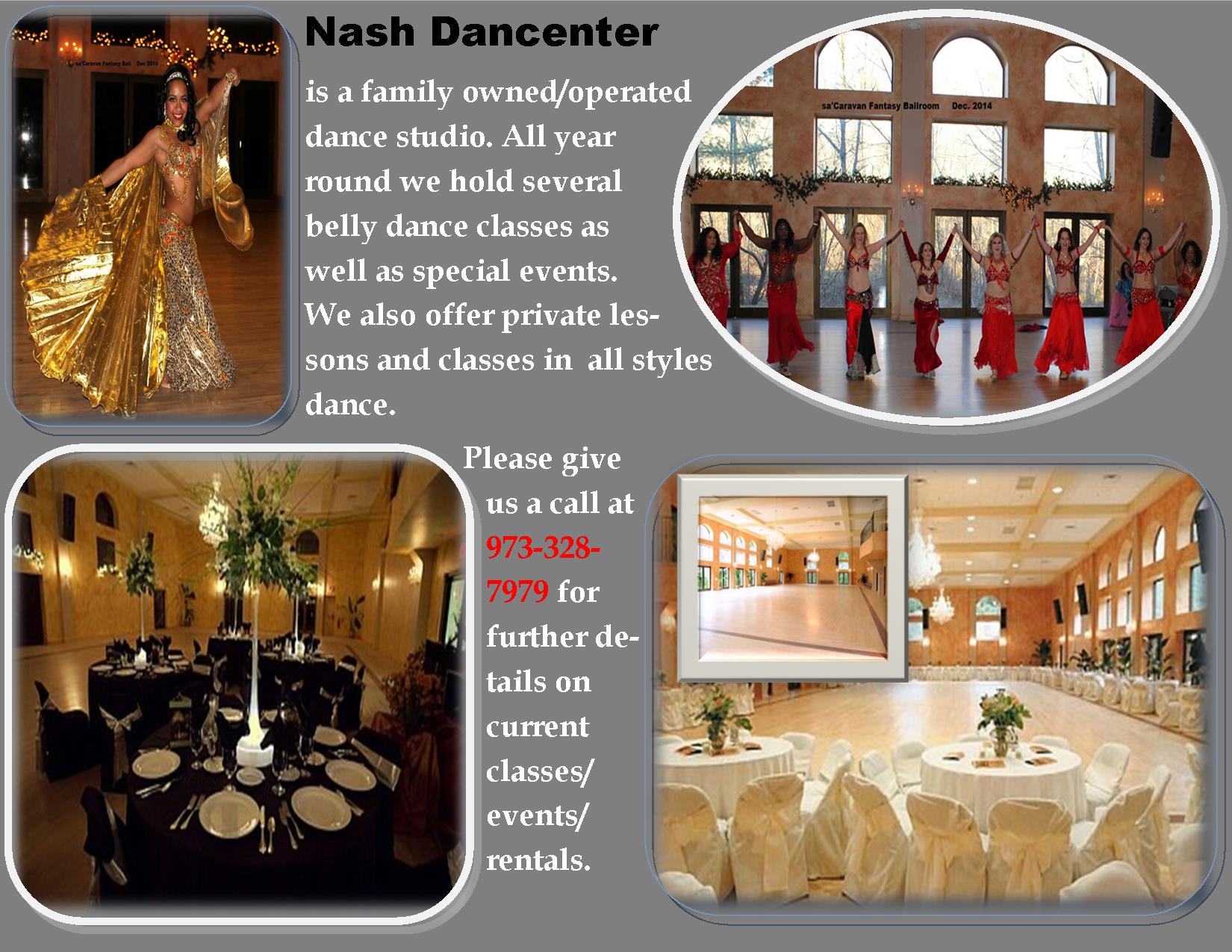
Nash Dancenter is a family owned/operated dance studio. We love serving clients of all ages and providing a relaxing atmosphere for the community to learn, practice and socialize. All year round we hold several belly dance classes as well as special events. We also offer private lessons and classes in all styles of dance. Please give us a call at 973-328-7979 for details and current classes/events. Randolph www.nashdancenter.com
Movement Journeys: 289 Stuyvesant Ave., 2nd Floor,
Lyndhurst, NJ 07071
Belly Dancing, Yoga, Pilates, Zumba, Salsa, Ballroom, Sculpting, Family Fitness
Phone: 646-228-0879. Website: www.movementjourneys.com "It's not about the destination; it's about the journey.
Om Dance Center: 650 Shunpike Road in the Chatham Mall. Advanced Intermediate Folk Bellydance with Shena, Improv Tribal Style with Raven,
Beginner Bellydance with Mariesa and Raven
Intermediate Bellydance with Mariesa (veil required)
Hip Hop Bellydance Fusion with Mariesa (kneepads required)
Bharatnatyam with Thajeswini Raj
Beginner Dumbek lessons with Luis Manuel
www.omdancecenter.com
Sharon Fit Belly Dance & Group Fitness Studio:
Belly dance, Yoga, Belly dance fitness and Hoop Dance classes
29 Alden Street Cranford, NJ 07016
www.sharonfit.com
(908)370-8882
Studio Yoga: Madison/Chatham NJ. INTERMEDIATE BELLY DANCE with Tasha : 11:30-12:30pm
BEGINNERS BELLY DANCE with Tasha: 12:45pm – 1:45 pm
email: staff@studioyoga.info
Studio Yoga Newsletter and Class Updates: www.studioyoga.info
Tribal Bellies Dance Studio
: Where every woman can be entrancing!
Tribal Bellies Dance Studio is the first belly dance studio dedicated to Tribal Belly Dance in the Philadelphia area. Vikki of Hipnosis is excited to be able to offer a full range of Tribal Belly Dance classes from beginner through advanced. The Tribal Bellies Dance Studio offers a variety of classes which include a 'level approach' to Tribal Improv, as well as specialty classes focusing on Form Refinement, Slow Silhouetting, and Drills. The studio also hosts regular workshops geared towards Specialty Skills, such as Sword, Floor Work, Veils, Skirts, etc. In addition to all of this, the studio hosts guest instructors to further feed your dance repertoire. Belly Dance can be enjoyed by women of all ages, shapes, and ability levels. This dance is a social activity that embraces the diversity of women and their bodies. Serving a community membership of over 70 dancers, there are various avenues of class opportunities, performance venues, and an onsite souk featuring the wares of Madam Marge and Crystal Kini Designs.
1810 County Line Rd, Huntingdon Valley, PA 19006
For classes at other studio locations
http://www.tribalbellies.com/classes.htm
TsunamiDance Studio:600 Main St Riverton NJ, 609/731-2429, www.tsunamidance.net
Director/Owner Jessica Moss has over twenty years of experience in dance performance, choreography, education, functional anatomy and Laban Movement Analysis. Classes are offered in Belly Dance, Modern Dance, Classical Ballet, Pilates and Children's Creative Movement.
Transformations For Women: 732-531-5400 (W), 732-948-9574 (C)
www.transformationsforwomen.com
Why take a class? Why not just buy a video?:
Most who have done so and then resorted to classes will tell you that there exist very few videos that cover the basics in depth regardless of what they claim. Concerns arise with not using the proper posture and not having the proper body strength and flexibility to perform what is being asked of the viewer. Videos are wonderful supplements for someone with a bit of knowledge in Belly Dance but they are no substitute for an Instructor.
For those venturing out to take a class for the first time:
First off…Belly Dancing is not reserved only for young and exotic looking females who are below a size 4. The dance accepts all regardless of age, size, ethnicity or gender. Having a physical disability will not necessarily exempt someone who wants to learn either as there are so many aspects of the dance to be a part of. You are not required to have prior dance experience. Most Instructors will assume unless told otherwise in a beginner’s class that you are, in fact, a beginner. They will also be able to tell if you have a background in dance. It is perfectly okay to have no experience, in some cases it is advantageous because you enter with an open mind and this is essential for a new student.
Each Instructor and class is different and there are many different styles of Belly Dance amongst the broad tent style terms of Tribal, Cabaret and Mix or Fusion. Some of our Instructors are listed under Defying Definition or Mix because either they prefer not to be categorized and fuse many elements or they specialize in a specific style that simply defies definition. If you are unsure of the different styles it is advisable to do a bit of research on the internet. You will come across many articles and we will list two national sites (see bottom of page) which provide a tremendous amount of information for Belly Dancers who are beginner thru advanced, hobbyist to professional. If still unsure, inquire with some of the Instructors listed on this site who would be more than happy to describe what they do. Some may even offer a free or reduced drop in rate so you may see what they do.
Finally: It is extremely important to understand that Belly Dance is not Exotic Dancing nor is it designed to entice members of the opposite sex . Sadly American Television and movies have greatly distorted the concept and understanding of Belly Dance. If entering a classroom for this purpose, it may be wise to reconsider as Belly Dance is a serious discipline not unlike other forms of professional dance. Belly Dance is designed for fitness and fun for a new student and as a professional discipline for future performers who seek...not sexual attention...but to express their passion and who have a full understanding of the history, culture and proper behavior of the specific discipline they have studied.
On choosing a teacher:
Most new students will seek an Instructor who is close in distance to them. As a dancer becomes more advanced they will be more willing to travel and seek a teacher they admire or one that teaches a style they desire to learn. When choosing an Instructor, make sure you have information on their background and training. They are required to know the form of dance that they teach well enough to teach it. Being a professional dancer in other forms of dance who takes a six to eight week crash course in Belly Dance is generally considered unqualified. A talented and seasoned performer however, does not ensure a good teacher and vice-versa. If you are seeking a class then you want a good teacher. In the world of Belly Dance there is no official manner in which to monitor teachers. There are certain major entities who offer certifications in their style and require rigorous training but aside from this there is no state or federal mandates. Many of our NJ teachers are professionally certified teachers, Elementary thru High School though. Most Instructors, regardless, take the profession seriously and their number one priority is injury prevention. However, many are not professional trainers nor medical personnel so it is important, as a new student, to know your own limitations and be honest about any medical conditions you have upfront.
As stated before, classes vary according to Instructors. Some classes are very fast paced and others very slow. Find one that is suitable for you. Ask yourself if you would prefer a class that moves fast and gets everyone working hard and dancing from the moment you step in the door or one where the instruction is slow paced and every aspect is broken down. Because you are a beginner, seek an Instructor who not only has experience with beginners but one who is patient and supportive. Costs for classes range generally between $10 to $15 per hour. South Jersey tends to have more reduced costs then the Northern region of the state and it is in direct correlation to overhead costs. If cost is a concern then it is important to keep in mind the quality of education you will be receiving and the Instructor’s costs involved in running a class which include facility costs, travel and sometimes insurance expenses. Not to mention, they, themselves have spent many years as students and have put much expense and time into their craft.
Some Instructors will have you sign a waiver for insurance purposes which generally means that they are not responsible if you should injure yourself. If you are not asked to sign anything then this most likely means that they work for a facility that cover costs and accepts responsibility. It is a way for Instructors to protect themselves in the event that something happens. Instructors do their best to prevent injury but again, each new dancer must know and understand their limitations.
You’ve found a class and want to make the experience a success:
If you have found a class, make sure that you know what you need to bring and what to wear at your first class. Some Instructors enjoy embellishments such as coin scarves and may even provide them for their students. Others regard it as a distraction in class. Ask first and respect the Instructor’s wishes.
First and foremost, keep an open mind. The movements, styles, clothing and music may seem strange at first. You may even believe that you can’t possibly do what is being requested of you but you will if you are willing to dedicate the time and hard work. Belly Dancing is not easy and it takes time. Many of the Instructors listed on our pages have a background that ranges from 5 to 30+ years of experience. Give yourself time and do not compare yourself to others. Each student comes in with a different level of ability and background as well as a different body. Some are just naturally more flexible and fluid then others. This never means that you won’t be able to succeed. You will build muscle, develop a better posture and hopefully feel better about yourself in the process.
While it is important for student and Instructor to exemplify respect for one another it is also important for fellow students to do the same. It is never acceptable to mock or belittle a classmate. It is also not acceptable to reproduce an Instructor's choreography without their permission. Paying for class instruction does not entitle students to ownership of various choreographies or methods. Understanding basic social and professional guidelines will make the experience more rewarding and beneficial to all those involved.
From the Instructor’s wish list: Please do not ask your Instructors to teach you how to dance like Shakira or Beyonce. While immensely talented, professional performers; their performance videos are not necessarily reflective of Belly Dance. Certain aspects tailored for music videos sometimes have little reflection on the art and are often customized for American audience. It is important to understand that they are not Belly dancers but professional entertainers. As well...certain movements would not be performed by a Belly Dancer due to cultural appropriation...which is crucial to understand.
Finally: Do not expect that you will be able to perform and/or teach in a few class sessions. It is just not realistic. There exists so much information to the world of Belly Dance that it would be impossible to compress it into one class session. An Instructor/performer must know so very many concepts and this requires years of experience. The saying that "One does not know what they don't know" rings true, regardless of previous dance training in other disciplines.
For the more seasoned student:
You have experienced the classes and have now fell in love! A good Instructor will do that for you sometimes as the passion is contagious. Have you decided what you want to do with your new skills and where you want to take them? Do you want to be a performer, join a troupe, be an Instructor someday or become a more serious hobbyist who wants to stay in shape and just loves to dance? Do you want to remain with your current Instructor or do you want to seek one who specializes in the area(s) you are seeking. This is the time when you must understand your Instructor’s limitations in addition to your own. Sometimes students prefer to remain with their current Instructor while supplementing their dancing with new styles or the addition of drumming and zil playing. Most Instructors will encourage this as a well rounded dancer is the best type of dancer to be. New Jersey offers quite a crew of specialized Instructors who are very much sought after in other regions of the country and internationally. If you want to be a Instructor then find a seasoned professional with long standing student success and observe their teaching methods. You also want to seek an Instructor who is well versed in the chosen style you wish to eventually teach. If you want to be a performer then seek those who have a performing style you admire. When entering a new class though…always seek the beginner’s level regardless of how much experience you have. Every style is different and every Instructor is different. If you find the beginner’s experience too slow for your taste and are able to perform on level with more advanced students, discuss your concerns with your Instructor. They will have a good idea of where you need to be and sometimes you need to trust their advice. Make sure you are learning the history of your dance as well. Being well rounded includes knowledge of the individual forms. You will encounter Instructors and performers though who believe many different things and may discount certain forms of the dance or conflict with one another on history, terminology and such. Do your research and decide for yourself. Most importantly though, make sure you enjoy the experience because this is what it is really all about! Happy Shimmies!
Great links:
http://www.joyofbellydancing.com/
Comments? Questions? Additions? Write us!
Tribal was originally derived from the stylings of Jamila Salimpour who created Bal Anat in the late 1960's in California. A student of Jamila's named Masha Archer later formed a troupe named the San Francisco Classical Dance Troupe which developed a unique style of dancing that was different from the current styles of belly dancing of the time. A student of Masha's named Carolina Nerriccio eventually went on to form an internationally known troupe by the name of Fat Chance Belly Dance. Fat Chance Belly Dance is credited with creating American Tribal Style (ATS) that incorporates a specific series of movements and utilizes improvisation for performance. Today, TrIbal encompasses many different styles from improvisational formats to solo dancers. A commonality exists with a specific type of posture and presentation. Tribal Style Belly Dance is an American creation with distinctive costuming representing the various styles and ever expanding by the creativity of troupes nationally and internationally. Despite this, one can still see the influences of Jamila Salimpour and Bal Anat and the many dimensions of the dance which combine aspects of many styles of dance such as Flamenco, Hip-Hop and Folkloric dancing. For information on the different styles of Tribal please visit: http://www.tribalbellydance.org ~ Anne Marie
The"Cabaret Style"...a User's Guide...
by Gia al QamarOne of the many things that draw dancers to belly dance are the fantastic costumes. Fans of sparkle and glamour and glitz find themselves falling in love with what is called the "Cabaret" style of dance (I call it Middle Eastern Nightclub style). Cabaret style is defined, not only by it's very sparkly costumes, but also in the presentation of the dance that is very different from folkloric or tribal. Cabaret is danced on stage as well as in restaurant settings at parties and special events.
So what is "Cabaret"?
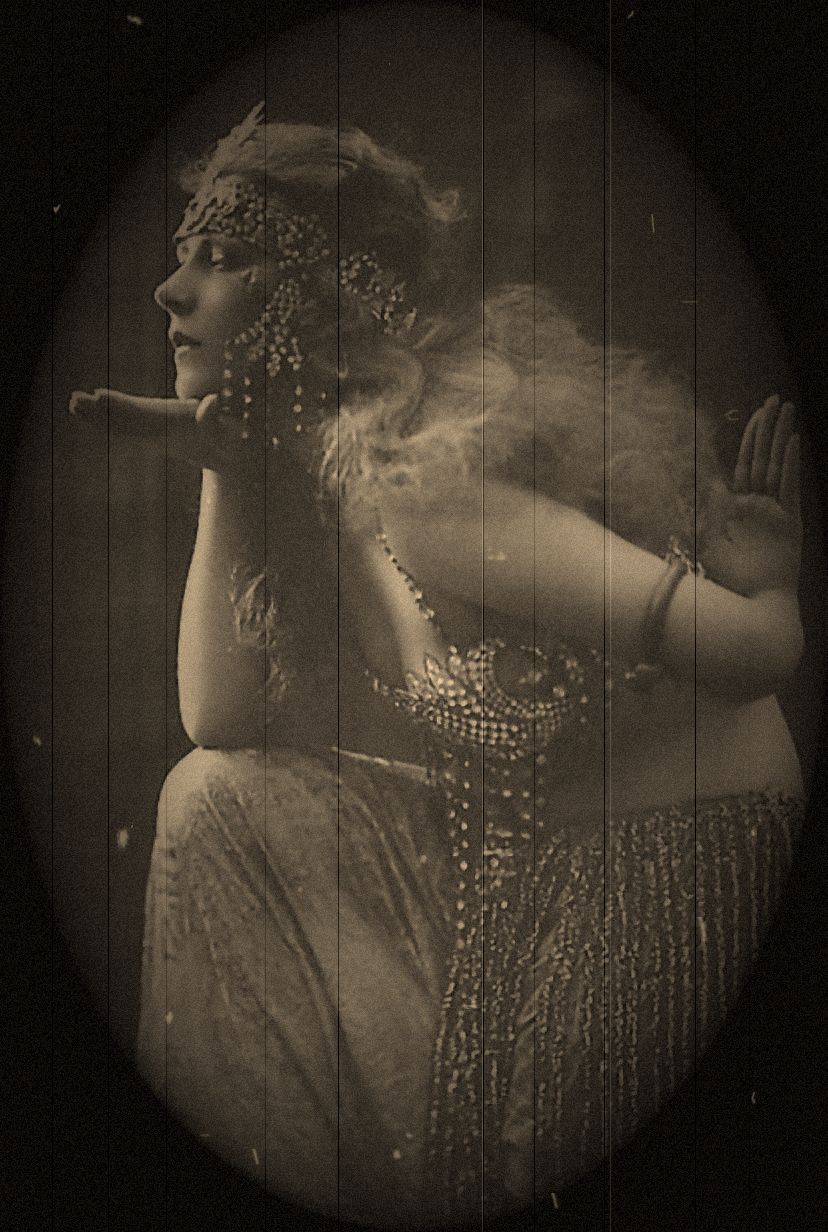
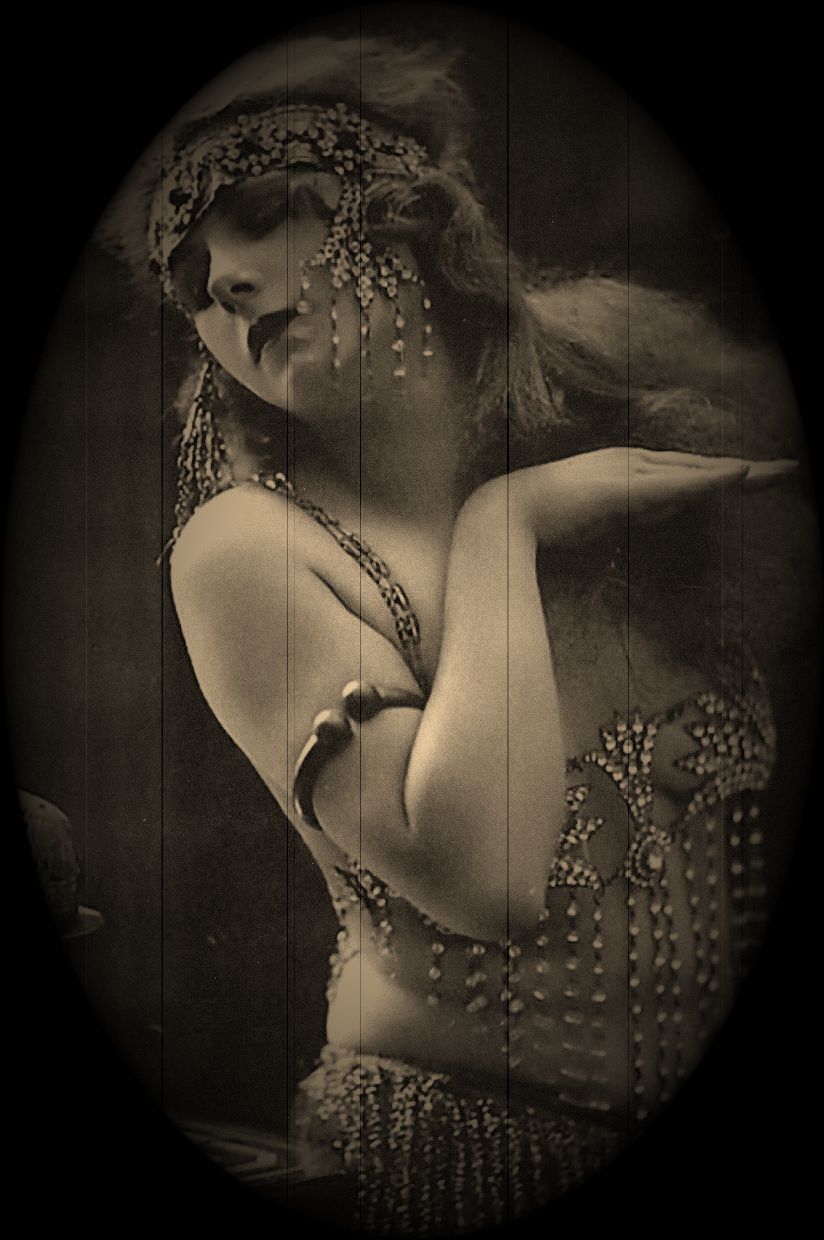
This is a style of dance that began in about the 1940s in Egypt. The movements were cultivated from the traditional folkloric roots as well as the 'balady' (meaning the popular dances) and made to be very 'showy', glamorous, elegant and ultra-feminine for the movies and stage! The American Busby Berkeley musicals were actually a HUGE influence on the costuming and staging of Egyptian Cabaret style dance...so our U.S. history is a part of Egyptian history as well!
The Moves...
Cabaret style is very much about controlled elegance. It is about expressing deep emotions, from joy to sorrow and everything in-between. You'll see all the elements of the dance in this style, hip lifts, drops, shimmies, undulations and isolations, locks and pops! The music used is classic, like Um Kalthoum and Mohamed Abdul Wahab and also embraces modern hits by Hakim, Amr Diab, Natasha Atlas or Nancy Ajram to name just a few!
Movements are usually fluid and controlled with sharp accents following rhythm of the tabla (drum). Upper body posture is KEY and use of the arms to frame movements is very important to the style.
Dancing is very much a vehicle for interpreting the music and allowing the audience to see visually what is being played. The music moved through the dancer! It can be danced in groups (troupes) but is most often performed solo. It is called Raq Sharki, Oriental Dance, Balady, and more!
Egyptian Style...
Thought to be the 'classic' form of this dance, the style of dancing from Egypt has changed and grown much over previous decades. Shimmies that used to be driven from the knees are now driven more in the thighs to make the movement more delicate and understated. Egyptian style doesn't use a lot of the stage, it is done in just a few feet of space, even on a large stage. There is no floorwork no veil work other than a standard entrance, and no popping and locking...everything is fluid and often layered on top of the little 'vibration' shimmies. You won't see an Egyptian style dancer stop and do arm or chest work...it's all included in the motion of the song...Feet generally do not leave the floor...kicks and turns are subtle and close to the ground.
The movements are very 'internal' being driven by the core muscles of the abs, back and inner thighs. Arms and hands are delicate and gently frame each nuance of the dancer!
Showing emotion is essential! Zills are still played by some dancers but has fallen out of favor with modern dancers. Upbeat songs are as much a favorite of the audience as the slow, improvisational taqsim. A drum solo usually is offered at least once in a show if not more! Cane is often a highlight of the show.
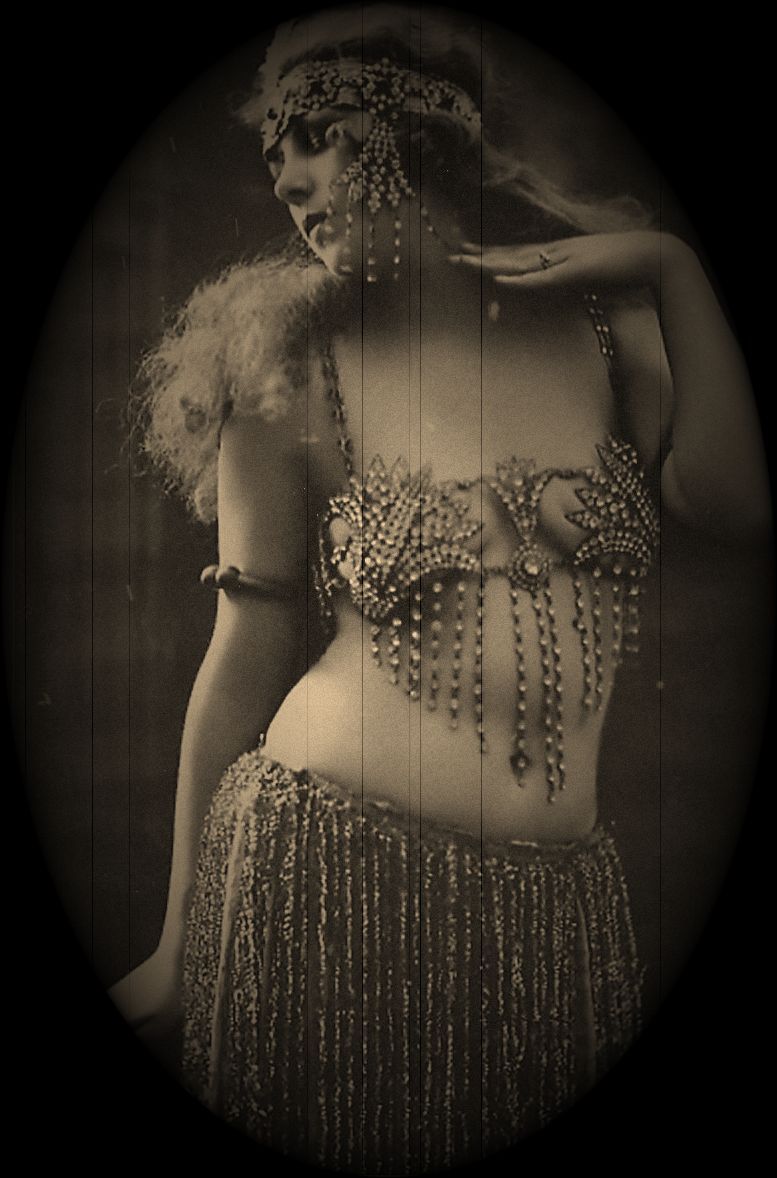
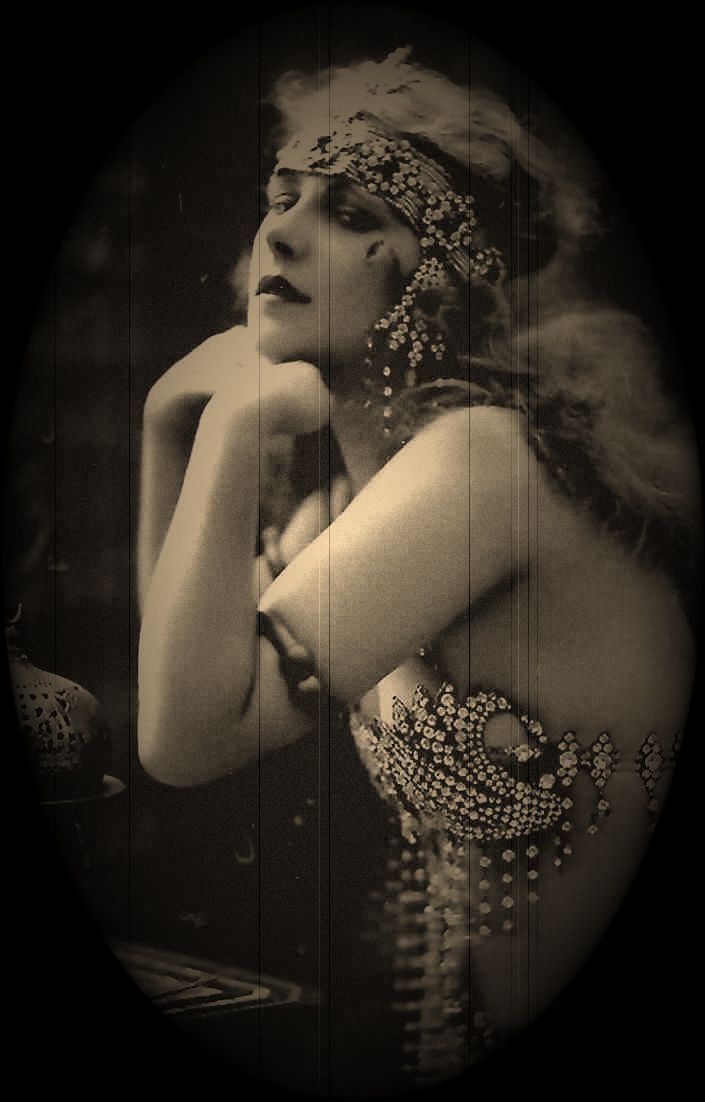
Costuming..."Old School" Egyptian style dancers wore traditional bedleh. "Bedleh" is the Arabic word for 'uniform' and what is used to describe the bra-and-belt combination that we know in this country as a belly dance costume. The set could be simple elegant fabric with or without additional decoration, or an over-the-top coin or jewel, bead, sequin and glass fringe-loaded work of art! An A-line chiffon skirt (2 panel or full circle) and matching wrist and hair bands finish the basic style. To this is always added lots of sparkly jewelry, earrings, bracelets, rings, arm bands...the sky's the limit!
The MODERN equivalent of this traditional style has come into favor over the last 5-6 years. It includes a more elegant gown look with a bra with little or no fringe and a streamlined straight skirt (sometimes with a flared bottom) and often no belt. The costume is made from lame, velvets, Lycra and fused dot specialty fabrics. The look is very couture and elegant.
Just a note...Belly covers are often worn for performances at Wedding or other parties where the show of too much skin may be offensive. Beledi dresses that are like one-piece bedleh is often another alternative to the 'old school' look!
Turkish Style...Like Egyptian style, the Turkish style of dance uses all of the same movements as its Egyptian cousin, but with a different 'feel'!
Unlike the conservative social & political climate that created the more subtle form of Egyptian style dancing, Turkish style is marked by the use of big movements and grand, upbeat Turkish and Middle Eastern music in addition to the Arabic classics and pop songs listed previously. Additionally, Turkish dancers perform to Turkish classics such as "Rompi-Rompi", "Shisheler", "Shashkin" and other favorites. Time signatures also differ, with 9/8s being the most widely used. The slow number in Turkish shows is usually a Chiftitelli, with or without rhythm.
The style is ebullient and flamboyant, with big shimmies, hip bumps, chest accents separate from other 'layering' hair tosses and accents throughout the music. This style dancer uses a bit more of the stage than Egyptian. The emotions are very much 'on display' in this style as well!
Floorwork is traditional and still performed in every show. Props, such as veils, zills and the balancing of a sword is often part of the show. Use of arms and hands (including traditional hand gestures unique to Turkish dancing) is very expressive. A Turkish style dancer may stop mid-song and just focus the audience's attention on her hand work or hip combo. The Roma (or Gypsy style as it has been incorrectly called) with its skirt accents and hand gestures has always been incorporated into Turkish Oryental style.
Costuming...Bedleh with full skirts are still very much a favorite of Turkish style dancers. Many also wear harem pants underneath, especially if they are performing on stage and when doing floorwork. Unlike the straight-cross belt of traditional Egyptian bedleh, Turkish belts usually have a "V" shape, but many designers have adopted the straight line as well. The look is opulent...many large crystal 'stones', sequins, beads, fringe is used. Skirts are chiffon sometimes layered to give a very robust look to the costume. Lots of jewelry, hairbands, necklaces, bracelets and more is used to finish the look. Costumes often come with matching wrist and ankle bands and a veil edged with beads.
American Style...Classic American style Belly Dance came into it's greatest popularity in the 50s-60s. It was then that most Americans and immigrant Middle Easterners could see dancing 'from their home countries' in great venues in NYC and NJ. The dancers were educated by some of the Middle Eastern dance masters as well as their American proteges. The combination of American jazz style dance with Middle Eastern movement gave a unique look to the style that includes not only the elegance and femininity of the Egyptian style, but also the drama and spark of the Turkish too!
Music is varied, from Greek, to Egyptian, Turkish to Arabic pop that sounds very American! The stage or dance area is used in it's entirety with large traveling steps and multiple turns. Zills, veils, sword, tray, cane, Isis wings is used (though not usually all in one show!).
One aspect of American style dancing that is always consistent is the use of what is called the 5-part set. The dancer does an upbeat entrance, followed by a slow rumba for her veil number, an upbeat pop song, a Chiftitelli and drum solo.
Costuming...The most popular mode for American style dancers is the traditional bedleh, bra and belt with skirt. In the 50s-70s, the look was usually a coin bra and belt with chiffon skirt...now you'll find American style dancers in mermaid style skirts, jazz pants, bras with unusual criss cross belly drapes...it's very creative and...like the dancing, very eclectic!
www.IDreamOfGia.com
Belly Dance by Gia al Qamar
Belly Dance Fitness is a form of dance aerobics with Middle Eastern movements to emphasize working the core muscles, but also incorporating yoga stretches and choreography for the cardiovascular benefits. The entire body gets a workout during this high-energy work-out. Added benefits are fun and laughter, which occur during every class, and the opportunity for creative expression and connection with feminine spirit and power in a group setting. ~ Yolanda @ www.myspace.com/yolandadancer
Belly Dance Fitness is different from general class because it is designed for fitness only, not for refining techniques, learning a specific style nor for performance.














-_Garwood-01.jpg)